By Bob Jensen
I’ve had the opportunity to talk with several anglers about the most recent open water fishing season. We’ve covered a lot of fishing topics in those conversations. One topic that comes up a lot is lures. Especially newer lures. A good number of anglers have their “go-to” lure, a lure that, when nothing else is working, they “go- to.” Many of those anglers are discovering, or have discovered, a new “go-to” lure.
In many places, and for many anglers, some form of a jig has been their “go-to” bait for a long time for a wide variety of fish. If it swims in freshwater, it’ll eat a jig. Jigs come in all styles and will catch fish in any season. They work well for active fish as well as the ones that aren’t so interested in eating. Jigs will catch fish in deep or shallow water. Very simply put, jigs have been fish-catchers for a long time and they still are.
The bait that has become a favorite of many anglers is a form of a jig. It’s fairly new to the fishing scene when compared to other lures. It’s called a bladed swim-jig. An example of a bladed swim-jig is the Thunder Cricket. It’s easy to fish, works in a variety of locations within a body of water, and it’s new to the fish. Fish can become conditioned to a bait style, so a bait that they’re not conditioned to can be more productive. Bladed swim-jigs have all the features that can put more fish on the end of our line.
Bladed swim-jigs were designed with largemouth bass in mind, and they certainly fool bass in a bunch of situations. But northern pike also have a fondness for bladed swim-jigs, as do walleyes and the occasional bigger and hungrier than usual crappie. A musky won’t ignore this style bait either.
Bladed swim-jigs can be fished through, over, and around a wide variety of fish habitats. They’re mostly weedless, so they can be worked through heavier patches of weeds when that’s where the largemouth are. They’re also a good choice when the bass are hanging out around docks, stumps, and other shallow water cover.
Baits of this design are very effective over large weed flats. They can be retrieved over the vegetation or allowed to run deeper through the weedy cover. This type of cover is home to most species of freshwater fish at some time of the year, and bladed swim-jigs will get them to eat. Use a slow retrieve when the water is cold, faster as it warms. Thread a KVD Blade Minnow on for maximum effectiveness.
Last thing. I’ve been fishing with young anglers more often the past couple of years. Young people it seems like to use baits that are kind of gaudy. Like some crankbaits. Crankbaits certainly catch fish, but most crankbaits have at least two treble hooks, and all those hooks have a way of getting into young hands that are inexperienced in landing fish. They also find the hands of the most experienced anglers. Bladed swim-jigs have a single hook that is effective in hooking fish and is also safer for hands.
Bladed swim-jigs are evolving. There is now a Tungsten Thunder Cricket and a Rattlin’ Thunder Cricket, and I’m guessing that more refinements are coming. When a bait becomes such an important tool for catching fish, revised versions are expected. Bladed swim-jigs have become an important part of many angler’s tool box.
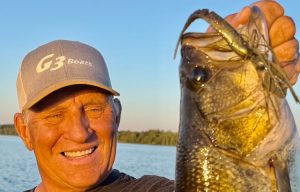
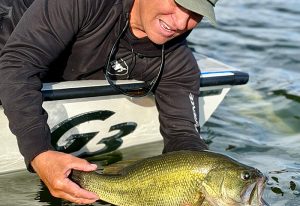
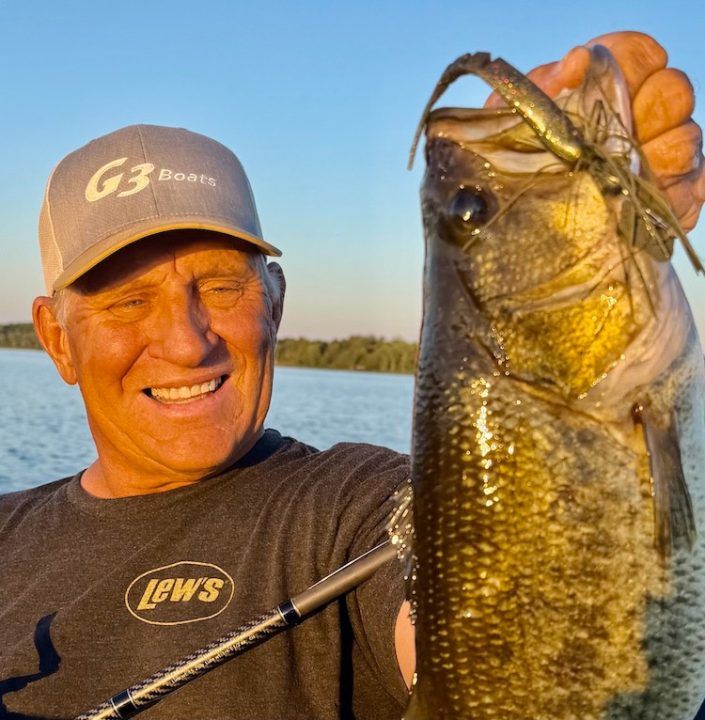
Photo Caption—Mike Frisch catches a variety of Midwest fish species on a Thunder Cricket.