By Mike Frisch & The Fishing the Midwest Team
During the 2025 open-water fishing season, I spent more time with a slip-bobber rod in my hands than during any other previous season since I was probably a kid. Here is what happened.
Early spring is panfish time in many places across the Midwest. Crappies and bluegills draw the attention of lots of anglers during this time as they move shallow to feed and then to spawn. Shallow, dark-bottomed areas that heat up quickly often draw spring panfish. Those areas are usually even better if they have forms of cover like fallen trees, weeds, and manmade cover like docks and boat lifts.
Slip-bobber set-ups utilizing small panfish jigs cast around these various forms of cover usually attract panfish. I targeted a couple lakes near my home with this type of cover and caught mostly crappies, and some big bluegills as well. My set-up was simple: a bright-colored 1/32-ounce Mr. Crappie Shoo Shiner Jig set a couple feet below a small slip-bobber.
I would cast the bait around the various forms of cover, let it sit a few seconds, twitch it a time or two, and then reel up and start the process again. By casting at multiple targets, I often found willing biters. In addition to keeping the bobber/bait moving, a second key was using a small slip-bobber with enough weight added above the jig so that it sat low in the water. A low-riding bobber is more resistant to being blown by the wind and is easier for spooky panfish to pull under.
During summer, I switched to bigger bobbers, a bit bigger jig, and utilized my forward-facing sonar (FFS) to look for schools of walleyes roaming around deeper areas, often underwater points or flats with adjacent drop-off edges in 12-25 feet.
I would use FFS to scan while quickly moving through likely fish-holding areas powered by my trolling motor. When fish would appear, I would hit anchor mode on my trolling motor to hold a good distance from them and cast my bobber set-up to the fish. I used mostly 1/16-ounce jigs tipped with portions of nightcrawlers.
Keys to this style fishing were again to keep my bobber riding low in the water, but also the use of the right rod. A long spinning rod with matching reel allows for long casts, plus it lets me quickly take up slack line and get a solid hookset on a fish a distance from the boat. The Lew’s 7’6” Speed Stick live bait walleye rod is a great option for this stye fishing with a very affordable price tag as well. I pair this rod with a 300 size Speed Spin CRX spinning reel, making for the perfect combo for casting bigger slip bobbers.
Slip-bobbers rods were in my hands for summer walleyes; in fall I moved back to crappies again utilizing bobber rigs, this time with FFS as well. Fall crappies like to roam basin areas. These fish were in small, tight groups of maybe 6 to 10 fish in each. They were roaming about halfway down the water in depths of 20-30 feet.
Again, I would move quickly looking for fish, anchor, and make long casts to the fish once found. The days I fished were windy, so again a low riding bobber was key. Plus, casting accuracy was very important as these fish were very tightly schooled and landing the bobber right on top of them was important. Again, the Shoo Shiner Jig was my bait choice, this time tipped with a small crappie minnow.
Regardless the bait choice, a jig below a slip-bobber is a productive way to catch fish during all open-water seasons. The tips just shared can hopefully help your bobber go down a bunch this year too!
As always, enjoy your time on the water and remember to include a youngster in your next outdoors adventure!
Mike Frisch co-hosts the popular Fishing the Midwest TV series. Visit www.fishingthemidwest.com to learn more.
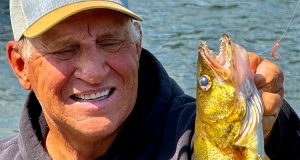
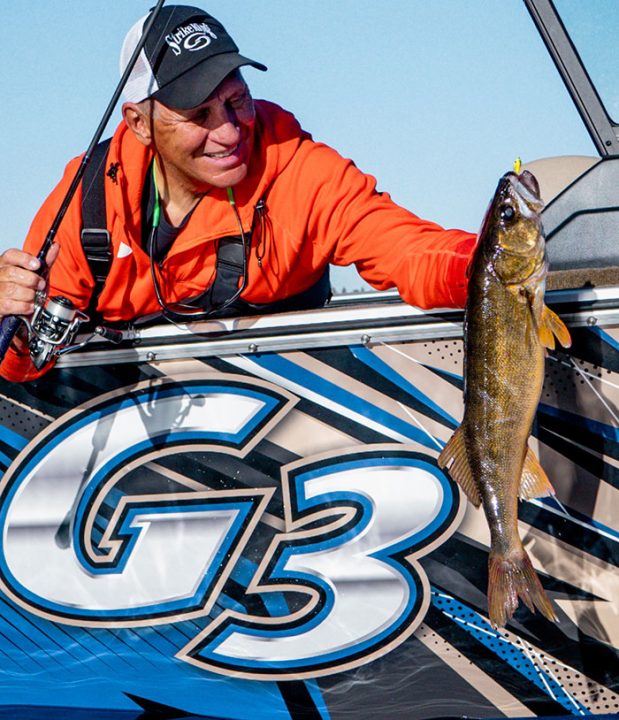
PHOTO – Mike Frisch lands a walleye. Walleyes are just one of the species vulnerable to slip bobber rigs.