By Bob Jensen
When we go fishing, we do all that we can to put the odds in our favor of having a fish bite our bait. Sometimes all we have to do to get a fish to bite our bait is put that bait near a fish. Other times it’s necessary to do something a little out-of-the-ordinary, such as imparting a slightly different action on the lure that is being used. Some anglers refer to this slightly different action as the “Magic Shake.”
The “Magic Shake” can come into play year ‘round. It’s especially a factor when a slow presentation is being employed. In open water, it’s most noticeable when jigging or drop-shotting. When fishing through the ice, making your lure do something different can be the difference between fish eating your bait and fish just looking at your bait.
Successful ice anglers keep a very close eye on their sonar. The sonar reveals the presence of fish and their activity level. Sometimes a fish will come in and eat a bait without hesitation. Other times a fish will come in and take a close look at your bait before eating it. But there are times, more than we might think, that a fish will come in, look at your bait, then swim away. This is when we need to put the Magic Shake into action. However, the “Magic Shake” is always changing. Sometimes the fish want the bait to be moved aggressively. Oftentimes though, they’ll want the bait moved slowly, or not even moved at all. The angler needs to experiment with different actions to determine what action the fish want on that day at that time. Figuring out what the fish wants is part of the fun of fishing.
In open water, fishing pressure or weather can make the fish more selective about what they eat. Again, much of the time a finesse presentation will be the best way to catch’em. Drop-shotting in deeper water can be very effective for a variety of fish species. We’re usually drop-shotting with lighter line that’s harder for the fish to see. The bait looks more natural and that can often be what it takes to get bit. We want to impart a very subtle action to the bait being used. A KVD Drop Shot Half Shell or Dream Shot will wiggle with the slightest amount of angler imparted twitches. The fish often like this.
When jigging for fish that are unresponsive, minimal action on the jig will often produce the most bites. Let’s say we’re after largemouth bass. The sky is bright. Experience tells us that the bass will be near cover. Tie on a Hack Attack jig and tip it with a Rage Craw. This jig has a rubber-legged skirt, and the rubber legs shimmy with the lightest of rod shakes. Pitch the jig into cover. The cover might be a log in shallow water or weed clumps in deeper water. Let the jig settle, then shake it a bit. The jig and trailer will move very subtly. If there’s a bass nearby, it will often be unable to resist this offering. Shake the jig a couple of times. If you don’t get bit, quickly reel in and pitch the jig to another spot. Eventually you’ll get bit.
There is no magic lure or lure action that guarantees fishing success. But when the fish are finicky, experiment with different retrieves and actions and, every now and then, you’ll discover a “Magic Shake” that the fish can’t resist.
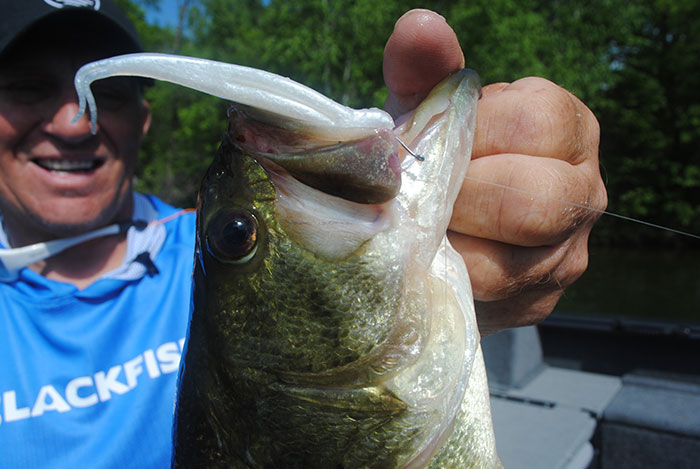
Photo Caption—The “Magic Shake” on a Z-Too plastic bait was too much for this bass to pass up.