
By Bob Jensen
There are several things that can determine how many fish we catch when we go fishing. Weather, season, time of day, fishing pressure, and a good number of other factors can lead to fishing success or not so much fishing success. Another factor is conditioning. More and more, accomplished anglers believe that conditioning has an impact on how many fish we catch. Some thoughts on fish getting conditioned to lures and lure presentations.
Mike Frisch is the host of Fishing the Midwest television. Mike spends more time on the water than anyone I know. Earlier this fall, Mike was on a spot that had produced a variety of fish species for him on recent fishing outings. On those outings, he used a shallow running crankbait over this particular weed flat, and had caught good numbers of largemouth bass, walleyes, and northern pike. On this day, he used the exact same crankbait over the exact same weed flat and caught nothing. Exactly nothing! His curious mind went to work. He wondered if the fish were gone or just not hungry. Mike decided to try a different bait. He tied on a Tungsten Thunder Cricket. He was confident that the fish in this lake had not seen a Tungsten Thunder Cricket before, as it’s a fairly new style of bait. One pass over the exact same weed flat resulted in bass, walleyes, and pike caught. Mike’s experience strongly suggests that fish of most species get conditioned to baits.
I have a really good memory of a day spent on Rainy Lake on the Minnesota-Ontario border with outdoor legend Toad Smith. We were chasing smallmouth bass with live bait rigs tipped with leeches. The smallmouth were eating them very willingly. Then they stopped eating them. We switched to nightcrawlers on our live bait rigs and the smallmouth resumed eating. Then they stopped again. Toad and I switched back to leeches, but the smallmouth wanted nothing to do with them. We knew the smallmouth were on this spot, so we started casting jigs tipped with plastic baits. The smallmouth ate the jigs and plastic very eagerly. They had become conditioned to the live bait presentation, but very aggressively ate the jig/plastic combo.
How long does the conditioning last? Several years ago on a popular walleye lake in Minnesota, a crankbait with a purple back and silver sides was noticeably better than the same crankbait in other colors. The word got out and the walleyes saw lots of those baits in the purple/silver color. It wasn’t long and the walleyes quit hitting that bait in that color, and that color hasn’t been as productive since then. However, the same bait in other colors has been catchin’em good.
One last example of fish becoming conditioned to a bait presentation. A medium sized river that I used to wade had a very good smallmouth bass bite in the spring. The bass would gather on a sand flat that was surrounded by deeper water. The bait of choice was a marabou jig tipped with a minnow. Orange was usually my starting color, but after catching four or five bass on orange, the bite would stop. A color change and the bite was back on. I could change jig color several times before the bass shut off completely.
Many expert anglers believe that conditioning is a factor in fishing success. When the fish quit biting the bait you’re using, try a different bait. You’ll probably catch more fish.
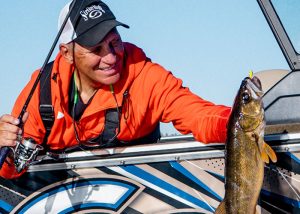
Photo Caption—Tim Emanuel knows that when the fish quit biting the bait they’ve been biting, it’s time to try a different bait.